
Adult Go Karting in Phoenix: Prices and Driver Requirements
A karting session isn’t just about the time on the track: driving time and total time at the venue are different. For adult go karting, understanding the session format helps you plan your race.
It’s natural to want to know how long you’ll drive, what you need to qualify, and what the price includes. These details vary by venue and session type, so check them before planning.
This guide breaks down how karting sessions work, what adult drivers need, whether double karts are an option, and what pricing may cover. You’ll also learn how to compare the details that matter, so you can choose a race experience that fits your plans and focus on the fun.
Key Takeaways
- Learn how to distinguish time on the track from the full visit when comparing race sessions.
- Understand how public racing and private events can shape your plans in Phoenix.
- See what track orientation and instructor coaching can help you understand before racing.
- Find out which driver and passenger requirements can vary by kart type, including double karts.
- Learn what pricing may cover and which session details can affect the total cost.
Where can I go kart racing?
Start by deciding whether you want to race during a public session or plan track time as part of a group event. Compare the venue’s location, schedule, and race format before choosing a date.
Public Race Availability
Public races are open to individual drivers and small groups, rather than reserved for a private event. Check the venue calendar for sessions on your preferred day. Confirm whether the listed time means driving time or the full visit, and look for event bookings that could affect the schedule.
Location matters, too. Compare the distance from your starting point with the session schedule. A farther venue may work for a planned group outing, while a nearby track may suit a shorter visit. Choose based on where your group is coming from and when you want to race.
Before choosing a session, check how the venue describes its race format. One race may differ from several races arranged as a full outing. Look for details about check-in, orientation, and time between races so you can plan beyond the driving itself. Read the terms and dates for any advertised promotion rather than assuming it applies to every session or event.
Karting Parties and Private Events
A private event gives a group a planned gathering with racing as part of the schedule. For a birthday, corporate outing, or other celebration, compare the event timeline with your group’s arrival and preferred race format. Check how track time fits into the rest of the event.
Group bookings can make it easier to coordinate racing around a shared schedule. A corporate event may focus on friendly competition, while a birthday group may want racing to fit around the celebration. Group size, available time, and event format all affect what works best.
Race formats vary. Some groups may prefer separate sessions, so drivers can race and compare results afterward. Others may want a tournament-style plan, if available. Confirm how races are organized, what the event includes, and whether participants receive the same driving opportunity.
For any booking, settle the key details first: choose a date, decide whether a public session or private event suits the group, and identify your preferred race format. Then compare the schedule and event details. This gives everyone a clearer picture of the day, from arrival to the final race.
Instructor coaching and track orientation
Indoor karting takes place in an enclosed facility, while outdoor racing uses an open-air track. Indoor racing avoids direct exposure to outdoor weather, while outdoor conditions can affect the experience and schedule.
An orientation can cover the kart’s controls, the track route, and how staff communicate instructions. Use the briefing to understand the course and how to respond to directions while driving. Knowing the route in advance helps you focus on steering rather than figuring out each turn as you reach it.
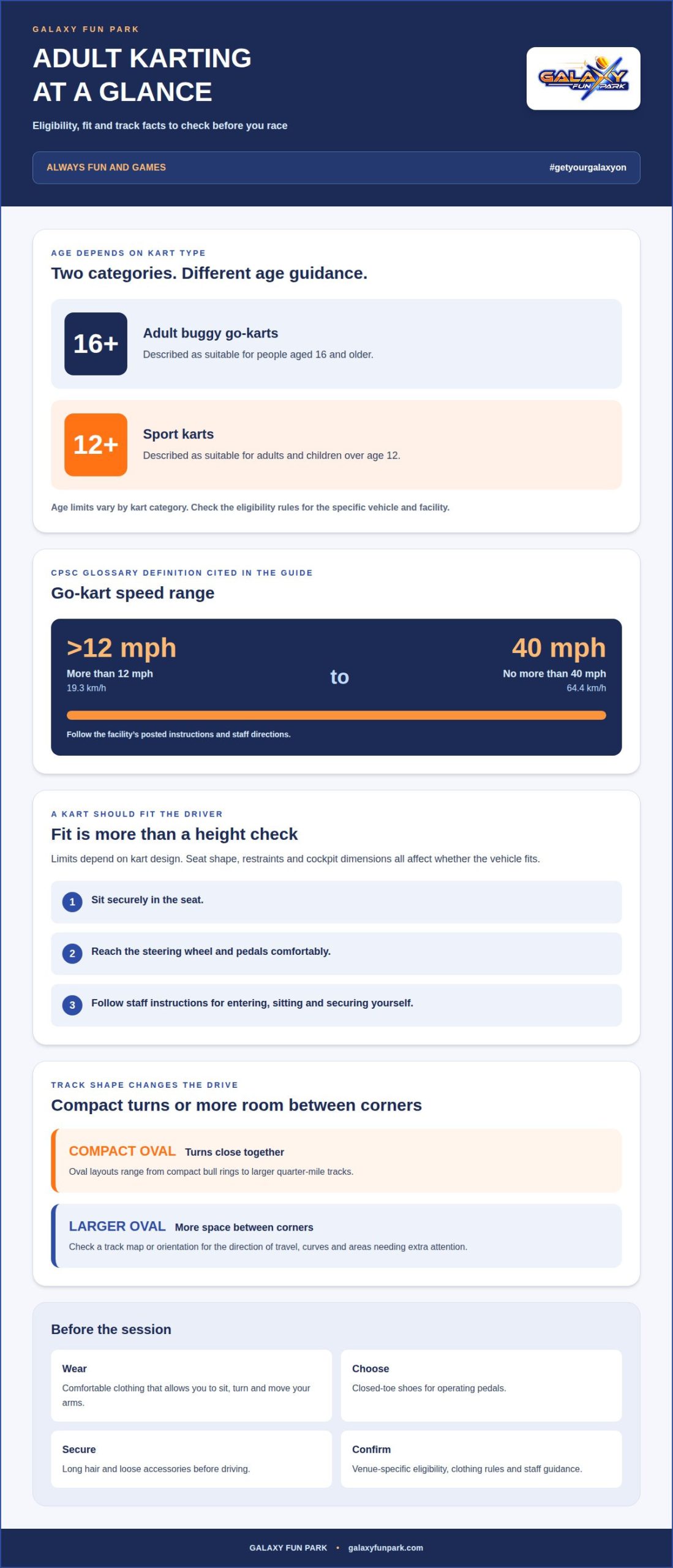
Coaching is most useful when it connects a specific instruction to the track layout. A staff member might explain how to approach a bend or where to reduce speed, then point out that feature during the orientation. Treat the briefing as a chance to understand the course, not a promise of professional racing training. The CPSC glossary defines a go-kart as having a maximum speed over 12 mph (19.3 km/h) and no more than 40 mph (64.4 km/h), so follow the facility’s posted instructions and staff directions.
Track shape affects the driving experience. Oval tracks range from compact bull rings to larger quarter-mile layouts. A compact oval places turns close together, while a longer track gives drivers more space between corners. Check a track map or orientation for the direction of travel, curves, and any areas requiring extra attention.
Staff can explain the briefing, organize drivers, and answer questions about the route. A clear orientation should cover the sequence: listen to the instructions, understand the track direction, and follow staff guidance before driving. Ask about any unclear controls or route details during the briefing, not while moving.
Each facility sets its own operating hours, which may differ between public sessions and private events. Check the listed hours and session times when planning, especially if you want to fit a race around other activities. Weather may affect an outdoor track, while an indoor facility keeps the course enclosed. Compare the setting, schedule, and orientation details to find a suitable option.
For an example of an indoor karting facility, explore the indoor attractions and see how racing fits into a broader visit.
Adult karting eligibility and driver requirements
Eligibility depends on the kart category and track rules. Age, physical fit, clothing, and health considerations can all matter before a session.
Age, Height, and Weight Requirements
Age limits vary by kart type. Adult buggy go-karts are described as suitable for people aged 16 and older, while sport karts are suitable for adults and children over age 12. Height and weight limits also depend on the kart’s design. Read the specific eligibility criteria for the vehicle you plan to drive, rather than assuming every circuit uses the same limits.
Fit matters as well as age. You need to sit securely and reach the steering wheel and pedals comfortably. Seat design, restraints, and cockpit dimensions determine whether a kart fits. Height alone may not answer the question, so consider your full driving position. Follow staff instructions for entering, sitting, and securing yourself before the session.
What to Wear
Choose comfortable clothing that lets you sit, turn, and move your arms without restriction. Closed-toe shoes are a practical choice for operating pedals, and long hair or loose accessories should be secured before driving. Avoid garments or items that could snag or distract you. The venue’s rules take priority, so follow its instructions before entering the kart area.
Dress for the facility and activity, not just the weather outside. For an indoor session, bring a light layer you can remove if the space feels warm. Keep pockets and accessories tidy, since a phone or dangling item can distract you. Follow any clothing instructions provided during orientation.
Health Risks and Restrictions
Karting involves steering, controlling pedals, and reacting to turns while the vehicle is moving. Drivers need to stay alert, follow instructions, and remain seated through the session. If a health condition could affect these actions, consider that before taking part. Follow the facility’s safety rules and tell staff about any restriction that could affect driving.
Read the participation rules before booking. They explain the venue’s eligibility criteria and restrictions for its karts or track. Age alone does not establish eligibility: drivers must also meet the relevant fit requirements and follow pre-race instructions. If you’re attending with a group, share the requirements early so everyone can plan.
For example, a group with drivers of different ages should identify which kart category each person plans to use. Age limits can differ between kart types, so matching each driver to the right option matters. Allow time for orientation and seating instructions before the session. Preparation helps everyone focus on the course, controls, and race.
Double karts and passenger requirements
A two-seater kart carries a driver and passenger in one vehicle, unlike a single-seat kart. Passenger access, age limits, and seating rules depend on the venue’s kart and track requirements.
Adult recreational karts are designed for leisure driving, but they may not suit every body size or experience level. A roomy-looking seat does not prove that a driver or passenger meets the fit requirements. Before choosing a two-seater, consider who will drive, who will ride, and whether both can sit securely.
Mid-sized karts may appeal to adults looking for a compact option, but “mid-sized” is not a standard vehicle category. Kart dimensions and passenger capacity are separate details. A smaller kart may still have one seat, while a two-seater needs room and restraints for both occupants. Use the venue’s listed kart categories and rules to tell them apart.
A two-seater changes the experience for both people. The driver controls the kart and follows the course, while the passenger rides along. This can suit someone who wants to experience karting without driving. However, not every passenger is eligible, and not every track has passenger karts. The venue’s rules determine who can ride and which kart is permitted.
Speed also varies by kart and track, so there is no single figure that describes every adult kart. The U.S. Consumer Product Safety Commission glossary defines a go-kart as having a maximum speed over 12 mph (19.3 km/h) and no more than 40 mph (64.4 km/h). That definition describes a broad category, not a promise about the speed of a specific indoor or outdoor rental kart.
For a passenger ride, first identify the driver and rider. Then check the vehicle’s capacity, seating arrangement, and eligibility requirements. If one person wants to drive while another rides, a two-seater is an option only if the venue permits that arrangement. In a single-seat kart, each racer drives separately.
Experience does not replace eligibility. Experienced drivers still need to fit the kart and follow its instructions; first-time passengers need to understand the ride rules. Course layout and kart design can affect which vehicles are available, so don’t assume one option works for every session.
Before choosing, match the kart type to your group’s needs: one seat for solo driving, or two seats for a driver and passenger where permitted. This helps everyone choose a suitable experience and understand their role on the course.
Karting prices
Karting prices depend on the session and booking format, so compare what each option includes. A single race, multiple sessions, and a group event may offer different amounts of track time or different arrangements.
Start with the session details. Check whether the option covers one race or several, and whether the stated time means driving time or the full visit. A multi-race booking may suit friends looking for more time on track, while one race may fit a shorter outing. Compare similar options, not just headline prices.
Kart type is another factor. Solo karts and two-seaters serve different needs, and the price may reflect the format. Group events can also differ from individual public sessions. Check what the booking includes, such as track access and event arrangements, before deciding if it suits your plans.
Competition-style formats may include several races or a planned event schedule. The total cost depends on the format and what it includes. For a group, establish how many people plan to drive and whether you want public sessions or a private event. These details make comparisons clearer without assuming every venue packages racing the same way.
Zipline pricing is separate from karting because it covers a different activity. Its cost depends on the facility’s offering and booking format, and eligibility follows that attraction’s rules. A zipline visit may have different participation requirements from a go-kart session. Don’t assume the same price structure or driver rules apply.
Compare zipline options by checking what the booking covers, the stated participation requirements, and whether the activity is sold separately or as part of a larger outing. If an outing includes several attractions, review the package details rather than treating zipline pricing as interchangeable with karting. Keep each activity’s requirements distinct.
Use the same checklist to compare costs: session format, number of races, kart type, event setup, and included attractions. Then match those details to your plans. A competition-focused visit with friends may need a different booking from a short practice session or group celebration. Compare the experience you actually intend to book.
Galaxy Fun Park
Galaxy Fun Park is an indoor family entertainment center with much more than go-karts. Alongside indoor go-karts, guests can enjoy trampolines, video games, bumper cars, laser tag, the Pluto Plunge drop tower, Moonwalk blacklight mini-golf, soft play, and food from the Cosmic Café.
Galaxy Fun Park also hosts birthday parties, group events, and corporate events, bringing racing and other activities together for shared fun. Where it’s always fun and games!
Contact Galaxy Fun Park to plan your next outing.
Make your next outing a shared adventure
Choose the kind of outing you want before settling on a venue. A friendly race, family day, or group celebration can each shape your plans. Naming the occasion first helps everyone anticipate the same experience.
GALAXY FUN PARK’s 65,000 sq. ft. corporate store in Raleigh, NC, serves as the model for its franchise opportunities. Franchise attractions aren’t limited to a fixed list: they can be expanded or customized to fit a building’s available square footage, bringing even more fun to guests. Whether you’re planning adult go karting with friends or a family outing, make time for an adventure everyone can enjoy.
Contact GALAXY FUN PARK to plan your race and set your next outing in motion!
Frequently Asked Questions
How long is a karting session?
Adult go karting sessions have no standard duration across U.S. tracks; each venue sets its own format. Check whether the advertised time means time on the track or the full visit. Allow time for arrival, orientation, and any wait before racing. If you have another activity planned, leave time afterward instead of treating the session duration as your total time on site.
What age and height requirements apply to adult drivers in the US?
Requirements depend on the track and kart, rather than one nationwide adult age or height cutoff. For example, Galaxy Fun Park’s Galaxy Speedway requires drivers to be at least 10 years old and 56 inches tall. Other tracks may set different limits, so use the requirements for the specific kart.
How much does adult go karting cost per race or session?
There is no standard U.S. price for a race or session. The cost depends on the booking format, number of races, kart type, and whether you choose public racing or a private event. Compare the same details across options, including track time and any separately priced extras. A single race and a multi-race booking are not like-for-like comparisons.
Where can I find tracks near me?
Search a map or directory for “go-kart track” with your area, then narrow the results by the type of racing you want. Check each track’s location, operating schedule, driver eligibility, and indoor or outdoor setting. For a group visit, review event booking details as well. These checks help you find a track that suits your plans.
What safety rules and equipment are required?
Follow the track’s posted rules and staff instructions, since equipment requirements vary by facility. At Galaxy Fun Park, closed-toe shoes are required on attractions, and every guest must obtain a waiver band. A parent or guardian aged 18 or older must sign for a guest under 18. Don’t assume that one venue’s clothing or equipment rules apply at another track.
Do I need a driver’s license or prior experience to race?
License and experience requirements depend on the track’s participation policy. Kart eligibility is separate from road-driving credentials: the venue’s age and physical-fit requirements still apply. First-time racers can use the orientation to learn the controls and course rules. Experienced drivers must also follow the facility’s instructions for the session.
How long is a typical race or session?
A race and a full session can mean different amounts of time. A session may include check-in and orientation, while actual driving time depends on the venue’s format. When comparing bookings, look for the stated track time and how races are organized. This distinction helps you plan the rest of your visit without assuming the terms mean the same thing.
How can adults reserve a session, and are walk-ins accepted?
Booking and walk-in policies vary by track and schedule. At Galaxy Fun Park, attractions are purchased on-site; group rates require at least 15 participants and must be booked at least 72 hours in advance with a deposit. For an individual visit, plan around the venue’s operating schedule and on-site purchase process. A private group booking follows different arrangements from a walk-in visit.